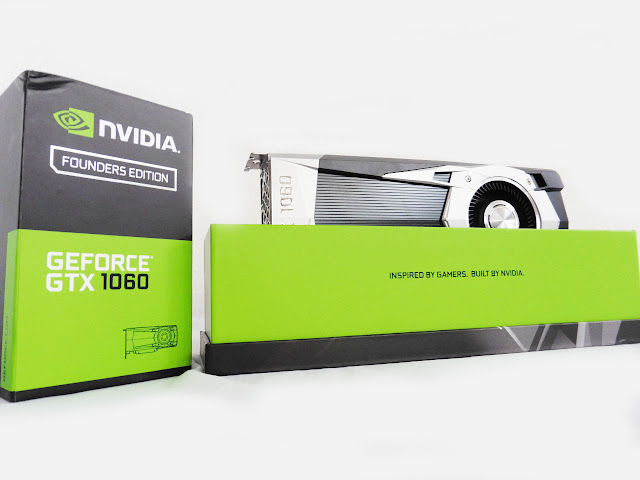
Rumors of NVIDIA's latest Pascal architecture-based GTX 1060 has caused quite a stir right after the launch of AMD's Radeon RX 480 with all the leaked performance benchmark, photos and technical specifications for the past few weeks. All that has come to an end with NVIDIA launching its GeForce GTX 1060 6GB today, as what the rumor suggests.
As you already know from all the leaks and rumors, the GTX 1060 comes with a total CUDA cores count of 1280 which is half of the GTX 1080's, base clock of 1506MHz that boosts up to 1708MHz, 6GB GDDR5 memory running on 8000MHz, 192-bit bus, can be powered with PSU as low as 400W on 6-pin PCIe connector, etc. What's left is the performance of the GTX 1060 itself, which we will be finding out in this review.
Before we continue any further, we would like to express our greatest thanks to the great peoples at CIZA Concepts and NVIDIA for arranging the GeForce GTX 1060 Founders Edition to Tech Critter's lab for today's review!
Specifications
Graphics Processing | GeForce GTX 1060 |
Core Clock | Boost: 1708 MHz / Base: 1506 MHz (With 1280 CUDA Cores) |
Memory Clock | 8000 MHz |
Process Technology | 16 nm |
Memory Size | 6 GB |
Memory Bus | 192 bit |
Card Bus | PCI-E 3.0 x 16 |
Memory Type | GDDR5 |
DirectX | 12 |
OpenGL | 4.5 |
PCB Form | ATX |
Digital max resolution | 7680x4320 (requires 2*DP1.3 connectors) |
Analog max resolution | 4096x2160 |
Multi-view | 4 |
Output | Dual-link DVI-D *1 HDMI-2.0b*1 (Max Resolution: 4096x2160 @60 Hz) Display Port-1.4 *3 (Max Resolution: 7680x4320 @60 Hz) |
Recommended PSU | 400W |
Power Connectors | 6 pin*1 |
Card size | H=42 L=249.7 W=111.2 mm |
The GeForce GTX 1060 Founders Edition

The GTX 1060 Founders Edition comes with a downgraded version of the Founders Edition cooler found on both GTX 1070 and GTX 1080, no transparent window, less metal parts on the shroud. Still, we can see some retaining traits of the stylish spaceship / race car design of the high-end Founders Edition cooler here on the GTX 1060 Founders Edition.


As it is a reference design card, the fan design is the blower type cooler. The only difference here is instead of having the hot air exhausted to the back of the card, the new Titan style cooler has an extra opening at the front of the card as well so hot air can be vented from the card faster in both directions instead.

You'll be getting the glowing 'GeForce GTX' on the GTX 1060 s well, something that has become one of the signature traits of NVIDIA reference coolers since the GTX Titan reference design.

Unlike the higher-end GTX 1070 and GTX 1080, the GTX 1060 isn't actually a full-length PCB graphics card and it takes up only 2/3 of the card's actual length. SLI support and metal backplate is something that you definitely will not be getting on the GTX 1060 founders edition, which can be explained if this is NVIDIA's approach in maintaining the launch price at $249 in order to compete with the AMD Radeon RX 480X 8GB which is priced at $239.
While there are users who can live without the metal backplate, the decision to disable SLI support for the GTX 1060 means a totally different thing. SLI support on mid-range graphics card means a lot to those who cannot afford the high-end graphics card and this decision actually displeased many of those who has been waiting for its arrival.


The odd looking solder joint nearby the filler section is an extension for the 6-pin PCIe connector located at the very end of the card. Aesthetics on the cable management is always an issue for a graphics card with shorter PCB as the PCIe connector are usually located in the middle of the card. While NVIDIA has taken the initiative to get that fixed with their GTX 1060 Founders Edition, a new problem arises - Removing the reference cooler for water cooling setup are virtually impossible because of the PCIe connector are now part of the reference cooler.

The display output option is pretty common nowadays, 1 x DVI-I connector, 3 x DisplayPort and 1 x HDMI port.
Performance Test
Test Rig Configuration | |
CPU Cooler | Raijintek Triton 240 |
CPU | Intel Core i7 4790K @4.6GHz |
Motherboard | ASUS Maximus Hero VII |
Memory | G.Skill TridentX 2400MHz |
Primary Hard Drive | Crucial M500 120GB |
Power Supply | Be Quiet! Straight Power 10 600W |
Chassis | Vector Bench case |
We mounted the GeForce GTX 1060 Founders Edition on our test bench as above and each and every benchmark is conducted in a room of about 31C° ambient temperature.
Performance
We ran a few graphically demanding games and synthetic benchmarks in our possession on a selected settings at 1080p, which is considered as high for much of our test as usual.The final result of each benchmark is presented in the form of the graph below:

Overclocking
We ran the same graphically demanding games and synthetic benchmark on 1080p with the highest achievable clock speed for both its memory and GPU that is stable enough to be able to complete each benchmark with the following values:
- 193MHz raise on the GPU core clock
- 538MHz raise on the memory clock
- Extra 16% gain on the power
That's quite a lot considering that this is a reference card and we managed to hit a beefy 2103MHz GPU clock speed on boost during our benchmark session.

Temperature
Temperature wise, we've observed a pretty decent temperature record of 36°C during idle and 74°C on load while running on default clock speed. Bumping up the GPU core clock with an extra 193MHz results in a slightly higher temperature of 78°C but it's still considered safe and it's optional to ramp up the cooling fan speed if you're looking into a much lower temperature.
Verdict
Other than the let down from not having support from SLI, the GeForce GTX 1060 Founders Edition didn't disappoint us when it comes to performance. The performance numbers from our test and the beefy GPU boost clock of 2103MHz achieved by overclocking the card with an extra 193MHz to the GPU clock is the proof that the GTX 1060 is a very capable card. It could do even better if it wasn't because of the NVIDIA Green Light program that is limiting the overclocking of the card, but that can be overcome with the soon to come custom BIOS from the enthusiasts community.
The NVIDIA GeForce GTX 1060 Founders Edition will retail at $249, a $10 extra compared to AMD's Radeon RX 480 8GB as the most affordable VR ready graphics card to date. Both the GTX 1060 and RX 480 are pretty capable for a mid-range graphics card, but paying $10 less, having Crossfire multiple GPU configuration support and getting 2GB extra on the memory with the Radeon RX 480 does seem to be a much better offer. Still, paying that extra $10 isn't that bad either as it will earn you the access to not only better performance, but also a whole new experience in capturing screenshots in-game with NVIDIA's Ansel, better VR experience with Simultaneous Multi-Projection, and more of NVIDIA's exclusives that you won't be getting with an AMD card.
Pros
- Combination of both aesthetics
- Solid build quality
- Good overclocking headroom
- Low power requirement
- Supports NVIDIA's Ansel and other NVIDIA's exclusive features
- Reasonable price for the performance it can deliver
Cons
- Lack of SLI support
- Higher price compared to other AiB partner's card with better cooling design


