Showing posts with label IFTTT. Show all posts
HP Announces Z Club Device-as-a-Service Program: Hardware Bundles at $108+ per Month

HP Announces Z Club Device-as-a-Service Program: Hardware Bundles at $108+ per Month

https://ift.tt/2Cqf9Wc

In addition to launching “Boosted” versions of its ZBook notebooks, HP has also introduced its Z Club device-as-a-service (DaaS) program. Under the terms of the program, select HP customers will be able to lend certain hardware bundles at a fixed monthly payment, and get a special Z Concierge service. The Z Club will be initially available only to select HP customers, if the company finds it successful enough, it may expand it in the future.

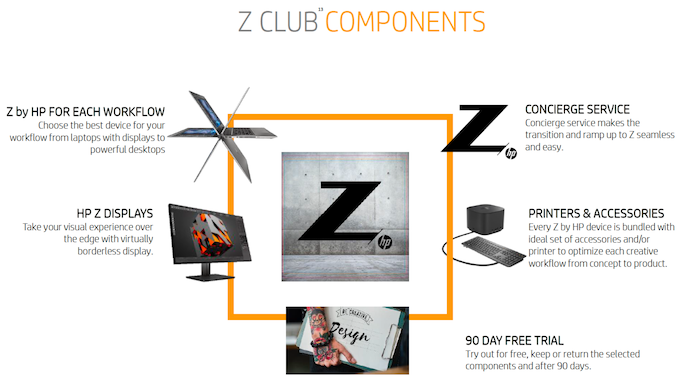
The Z Club DaaS program is aimed at creative professionals, such as artists, graphics designers, photographers, and video editors. For each group HP will offer a special hardware bundle. Furthermore, it will offer a choice of components and accessories that users may install themselves and find out how certain hardware affects their workflow. Select customers of HP that will be offered membership in the Z Club will be able to tryout HP’s hardware and components bundle for free for 90 days and in that period,  they will be able to configure systems however they see viable. In addition, Z Club members will be offered Z Concierge service available 24/7. The latter will provide recommendations concerning usage of hardware and software to simplify transition to HP Z workstations.

Initially, HP will offer six hardware packages for different workflows:

The Artist’s Bundle will include HP’s ZBook x2 with Pen, HP’s 24-inch DreamColor 24x display, a 1 TB external drive, wireless keyboard & mouse, collaboration software, as well as Z Concierge and next-day business service. Montly cost of this package will be at $156, exact specs are listed in the table below.

The Graphics Designer’s Bundle will include the HP ZBook x360 with Pen, HP’s DreamColor 24x monitor, a 1 TB external storage device, wireless keyboard & mouse, and the aforementioned software and services. This package will cost $167 a month.

The Video Editor’s Bundle will consist of either HP Z2 Tower or HP Z4 Tower desktop PCs, an HP Z38C curved display, or two 24-inch monitors (see the table for details). Depending on exact configuration, the package will cost from $183 to $210.

The Photographer’s Bundle will feature the HP Z mini workstation or HP ZBook x360 with Pen, a 24-inch display, and a printer. The package will be available for $108 to $180 a month, depending on exact hardware specs.
Keeping in mind that HP intends to offer its customers a choice of hardware to install themselves, actual monthly payments will differ from those of canonical bundles. Meanwhile, a quick analysis of hardware packages and their prices indicate that montly payments are about 27-34 times lower than the current cost of hardware. That said, it makes a great financial sense to rent the workstations when using them for less than 27 - 34 months. At the same time, it will be cheaper to buy hardware if you plan to use it for three years or more.

HP Z Club Hardware Bundles
 ConfigurationApproximate* Price of Hardware at HP.comMonthly Cost
Artists's BundleHP ZBook x2 with Pen
14-inch 4K IPS LCD
Intel Core i7-8650U
32 GB of DDR4-2133 RAM
1 TB PCIe SSD
NVIDIA Quadro M620 2 GB
+
HP DreamColor Z24x
+
Wireless Keyboard & Mouse
+
1 TB external drive
+
Services
$5362$156
Graphics Designer's BundleHP ZBook Studio x360 with Pen
15.6-inch 4K LCD
Intel Core i7-8750H
32 GB of DDR4-2667 RAM
2×512 GB PCIe SSD
NVIDIA Quadro P1000 4 GB
+
HP DreamColor Z24x
+
Wireless Keyboard & Mouse
+
1 TB external drive
+
Services
$5738$167
Video Editor's Bundle 1HP Z2 Tower
Intel Core i7-8700K
64 GB of DDR4-2667 RAM
Z Turbo 512 GB PCIe SSD
4 TB 3.5-inch 7200 RPM HDD
NVIDIA Quadro P5000 16 GB
+
HP DreamColor Z24x+ HP Z 24-inch LCD
+
1 TB external drive
+
Wireless Keyboard & Mouse
+
Services
$5374$183
Video Editor's Bundle 2HP Z4 Tower
Intel Core i7-7820X
64 GB of DDR4-2667 RAM
Z Turbo 512 GB PCIe SSD
4 TB 3.5-inch 7200 RPM HDD
NVIDIA Quadro P5000 16 GB
+
HP DreamColor Z38C Curved LCD
+
1 TB external drive
+
Wireless Keyboard & Mouse
+
Services
$7090$210
Photographer's Bundle 1HP Z2 Mini
Intel Core i7-8700
32 GB of DDR4-2400 RAM
Z Turbo 256 GB PCIe SSD
1 TB 3.5-inch 7200 RPM HDD
+
HP DreamColor 24x LCD
+
1 TB external drive
+
HP Photosmart Printer
+
Wireless Keyboard & Mouse
+
Services
$2937$108
Photographer's Bundle 2HP ZBook x360 with Pen
15.6-inch 4K LCD
Intel Core i7-8750H
32 GB of DDR4-2667 RAM
2×512 GB PCIe SSD
NVIDIA Quadro P1000 4 GB
+
HP 24-inch
+
1 TB external drive
+
Wireless Keyboard & Mouse
+
HP Sprocket Printer
+
Services
$5479$180
Note*Since we do not know exact configuration, actual prices may be different than the ones we picked at HP.com on 10/15/2018.

Related Reading:


from AnandTech https://ift.tt/2pYztqd
via IFTTT
We Test a $1,000 CPU From 2010 vs. Ryzen 3

We Test a $1,000 CPU From 2010 vs. Ryzen 3

https://ift.tt/2LTRRdr


#ThrowBackThursday Today we're going to have a bit of benchmark fun as we test out a processor we reviewed in 2010. The Core i7-980X was a hexacore beast, but how does it stack up 8 years later? To find out I'm going to compare it with a whole heap of...

Read Entire ArticleRead Comments


from TechSpot https://ift.tt/2LnAuoW
via IFTTT
iBASE Launches MI995 Mini-ITX Intel CM246-Based Board for Xeon E

iBASE Launches MI995 Mini-ITX Intel CM246-Based Board for Xeon E

https://ift.tt/2yJj2SQ

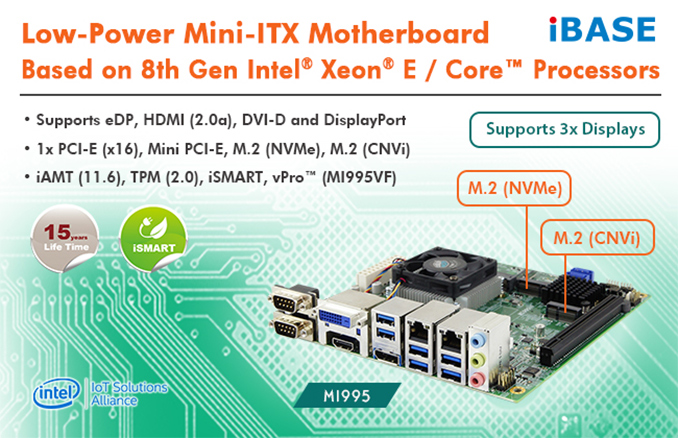
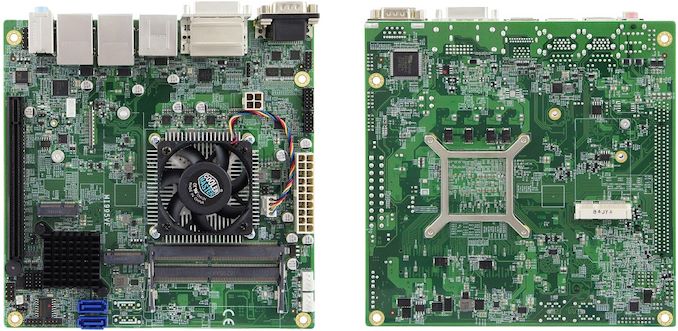
iBASE introduced one of the industry’s first Mini-ITX motherboards for Intel’s Xeon E processors on Tuesday. The MI995 is based on Intel’s mobile CM246 PCH and is aimed at low-power miniature specialized PCs. Meanwhile, small does not mean limitations, so the MI995 has nearly all the expansion capabilities its bigger brothers do.

The iBASE MI995VF-X27 is based on Intel’s CM246 chipset designed for laptops and supporting Intel’s Xeon E processors in FCBGA1440 packaging for mobile workstations. The particular model carries six-core Xeon E-2176M CPU. In addition, the manufacturer also offers the MI995VF-8850 and MI995VF-8400 platforms featuring the QM370 PCH as well as six-core Core i7-8850H and quad-core Core i5-8400H processors respectively. The Xeon-powered SKU supports up to 32 GB of ECC memory, whereas the Core-powered models can carry up to 32 GB of non-ECC DRAM. All the SKUs feature a TPM 2.0 module, and support vPro, iAMT 11.6 remote management, and iSMART 3.5 technologies.

When it comes to expandability, the iBASE MI995 motherboards feature a PCIe 3.0 x16 slot for graphics cards, a mini-PCIe slot, an M.2-2280 slot for SSDs, an M.2-2230 slot for CNVi Wi-Fi solutions, two or four SATA connectors, and so on.

Moving on to connectivity. The MI995 is equipped with two Intel GbE controllers, a Fintek F8196D-I chip for four COM ports, three display outputs, (DisplayPort, DVI-D, HDMI 2.0), six USB 3.1 ports, and audio connectors. As noted above, the motherboards may be outfitted with an optional 802.11ac Wi-Fi CNVi module.

iBASE officially positions its MI995 motherboards for digital signage, gaming, entertainment, and POS applications. Even out of the box, the platform can support multiple displays. Once equipped with a discrete graphics card, the system gains both GPU performance and additional display outputs, just what is needed for digital signage and gaming applications.

iBASE's MI995 Motherboards
 MI995VF-X27MI995VF-8850MI995VF-8400
CPUsIntel Xeon E-2176M

6C/12T
2.7 - 4.4 GHz
12 MB cache
45 W
Intel Core i7-8850H

6C/12T
2.6 - 4.3 GHz
9 MB cache
45 W
Intel Core i5-8400H

4C/8T
2.5 - 4.2 GHz
8 MB cache
45 W
PCHIntel CM246 + Fintek F81966D-I controller
GraphicsIntel UHD Graphics from CPU
PCIe 3.0 x16 slot
Display Outputs1 × DisplayPort 1.2
1 × eDP header
1 × DVI-D
1 × HDMI 2.0a
Memory2 × DDR4 SO-DIMM
Up to 32 GB of DDR4-2667
ECC or non-ECC, depending on CPU
Slots for Add-In-Cards1 × PCIe 3.0 x16
1 × miniPCIe
EthernetLAN 1:
Intel I219LM Gigabit LAN PHY (MI995VF-Series)
Intel I219V Gigabit LAN PHY (MI995EF)
LAN 2:
Intel I210AT Gigabit LAN (MI995VF-X27)
Intel I211AT Gigabit LAN (MI995VF-8850/8400, MI995EF)
Storage4 × SATA 6 Gbps
1 × M.2 (PCIe 3.0 x4 or SATA)
2 × SATA 6 Gbps
1 × M.2 (PCIe 3.0 x4 or SATA)
AudioRealtek ALC888S-VD2-GR
USB6 × USB 3.1 Type-A
4 × USB 2.0 Type-A via header
Serial Ports2 × RS232
2 × RS232/422/485
Wi-FiM.2-2230 slot
Operating Temperature0°C~60°C (32°F~140°F)
Form-FactorMini-ITX (170 mm × 170 mm | 6.7" × 6.7")

iBASE already lists MI995 motherboards on its website, but has not touched upon pricing and availability timeframe.

Related Reading

Source: iBASE


from AnandTech https://ift.tt/2yJKSOx
via IFTTT
AMD Zen 2 could be five times better than Ryzen 2nd Generation CPUs

AMD Zen 2 could be five times better than Ryzen 2nd Generation CPUs

https://ift.tt/eA8V8J

AMD Zen 2 – AMD's rumored 7-nanometer architecture for processors – is still months away from its expected CES 2019 reveal, but we’re seeing a slow trickle of details come out.

AMD Zen 2 will supposedly feature a 13% increase in instructions per clock (IPC), otherwise known as the instructions executed for each clock cycle. This is impressive because it’s a nearly five-times increase in IPC compared to the 3% increase we saw from the first Ryzen processors to Ryzen 2nd Generation, i.e. Zen to Zen+ architecture.

This latest rumor comes from Bits and Chips, an Italian technology site that claims to have gotten the information from an ”employee of a big company in the know,” who was the source of previous Intel Kaby Lake G leaks that proved to be true.

If the leaks are correct, this increase in IPC could be monumental even in the face of Intel’s rivaling Coffee Lake Refresh processors. Considering the jump from 14nm Zen chips to 12nm Zen+ chips was already impressive in our reviews of the Ryzen 5 2600X and Ryzen 7 2700X, 7nm Zen 2 delivering almost five times the performance would be a game-changing improvement.

The only other small detail we may know about Ryzen 3rd Generation processors with Zen 2 is they could make 8-core and 16-thread processors commonplace – even for the lowest tier Ryzen 3 CPUs. Of course, however AMD’s 7nm processors shake out, you can expect us to report on them live from CES 2019.

Via Hexus 


from TechRadar: computing components news https://ift.tt/2PDLwoh
via IFTTT
Intel to Split Manufacturing Group into Three Segments

Intel to Split Manufacturing Group into Three Segments

https://ift.tt/2yNknrQ

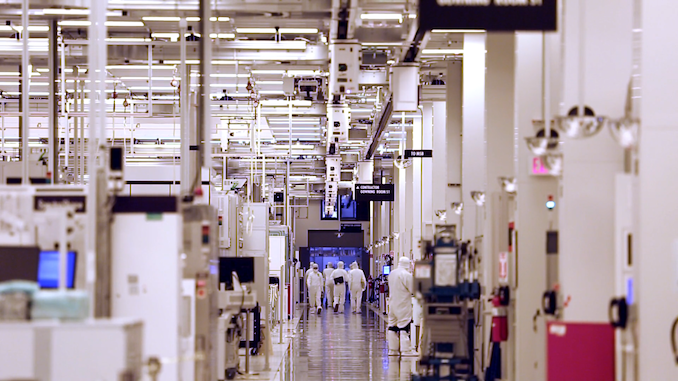
News today from OregonLive, a reputable source on news out of Intel, has posted that Intel is set to reorganize its manufacturing group. Spurred by the retirement of Sohail Ahmed next month, who has led the group since 2016, the Technology and Manufacturing Group will be split between the Technology Development, Manufacturing and Operations, and the Supply Chain.

Intel’s delays in its 10nm process technology have been extensively discussed, although the reasons behind it have rarely been aired in public. The process technology was originally set to have been in producion in 2016, and although Intel officially ‘shipped for revenue’ an obscure 10nm part in 2017, we are still waiting on the 10nm process to hit the primetime. Normally we expect to see a new major manufacturing process every 18-36 months, however the difficulties Intel has faced by attempting to implement a raft of new features down at the 10nm level have proved bigger than expected.

After the retirement of Ahmed, the full three groups will be headed up by different managers already at Intel:

  • Technology Development, to be led by CTO Mike Mayberry*
  • Manufacturing and Operations, led by Ann Kelleher
  • Supply Chain, led by Randhir Thakur

*Mike Mayberry was the head of Intel Labs. Rich Uhlig will be the new interim manager for Intel Labs.

How the three groups will work together has not yet been determined. As this is still during the transition to 10nm, there could be additional challenges in splitting the groups. This is also on the back of Intel still not having a CEO, after Krzanich was removed earlier this year. Given Intel’s predicted six-month search for a new CEO, we should be hearing about it soon.


from AnandTech https://ift.tt/2AfbTLI
via IFTTT
EKWB Velocity CPU and Vector GPU Water Block Preview.

EKWB Velocity CPU and Vector GPU Water Block Preview.

https://ift.tt/eA8V8J

Coinciding with the release of Nvidia’s RTX series of graphics cards, EKWB has launched their new line of water blocks for both GPUs and CPUs . The Velocity (CPU) and Vector (GPU) lines are part of a larger premium line up called Quantum. “It has been five years since EK initially introduced the CSQ design language, …

- Post EKWB Velocity CPU and Vector GPU Water Block Preview. appeared first on Modders-Inc. #moddersinc #voidyourwarranty #casemods


from Reviews – Modders-Inc https://ift.tt/2Owogfp
via IFTTT
Arm Announces Neoverse Infrastructure IP Branding & Future Roadmap

Arm Announces Neoverse Infrastructure IP Branding & Future Roadmap

https://ift.tt/2pVjZTZ

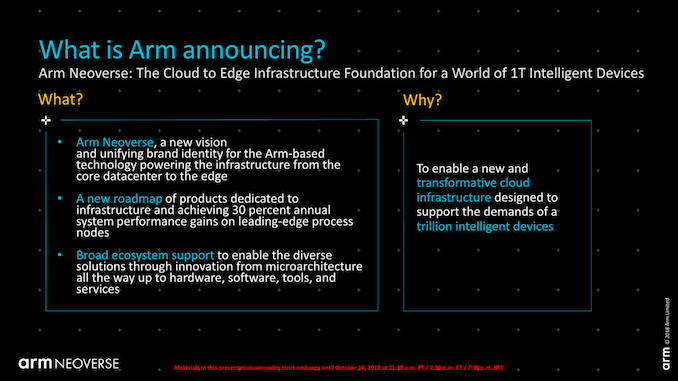
Among of the first announcements coming out of Arm’s TechCon convention in San Jose, is the unveiling of Arm’s new infrastructure branding and a sneak peek at the product roadmap for the next 3 years.

Up till today, the Arm’s IP portfolio for the infrastructure market didn’t differentiate itself much from the regular consumer IP. Today this now changes, as Arm tries to convey its dedicated focus in this market. The new IP portfolio which will see broader announcements over the coming months and years, is now dubbed “Arm Neoverse”.

The Neoverse branding is supposed to be live alongside the usual consumer device oriented Cortex IP branding, meaning that at some point we’ll see a new Neoverse CPU announced whose use-cases are meant to be in the infrastructure space.

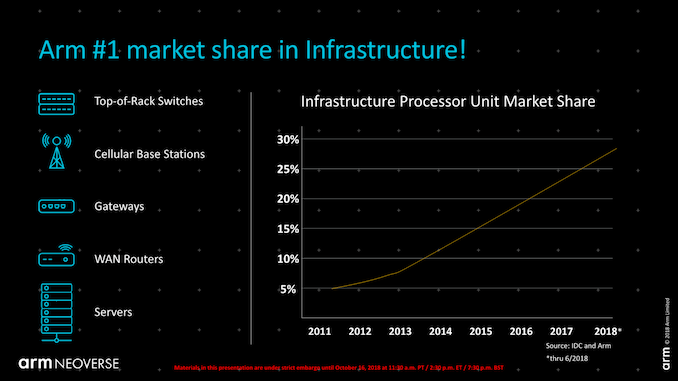
Arm showcases that over the last several years, they’ve been able to capture a significant amount of market share in infrastructure devices. What infrastructure devices actually means, is any kind of non-end user device, such as networking equipment, going from switches, base stations, gateways, router, and most importantly also servers. Here the various Arm vendors have reportedly gained up to a 28% market share.

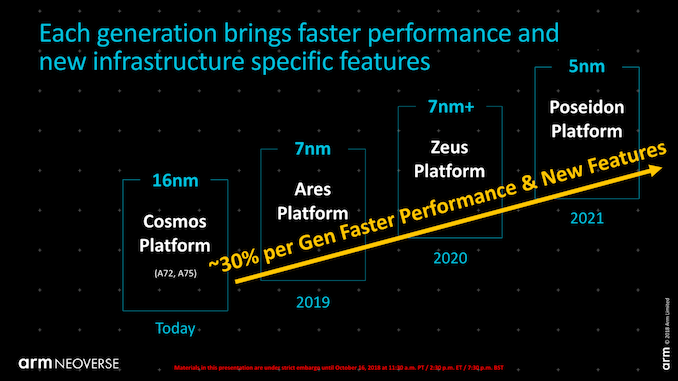
The biggest surprise today was that Arm again has publicly published the roadmap for the next several years, revealing the codenames of the infrastructure focused CPU and platform IPs. As such, we finally see the Ares, Zeus, and Poseidon codenames acknowledged. The CPU IPs based on these codenames should be the sever-oriented counterparts to Enyo/A76, Deimos and Hercules, the latter of which would remain under the Cortex branding. What the differences between the Cortex and Neoverse cores are is still unclear, but among the many possibilities, it’s not hard to imagine that we’ll be seeing SVE implemented in the server IP first.

Arm is also seemingly pushing the performance projections, and promises a 30% jump in performance for each generation over the coming years. This figure is more aggressive than the 20 to 25% quoted CAGR for the Cortex based CPUs in consumer devices, so we’ll likely see more differentiation in the infrastructure IPs.

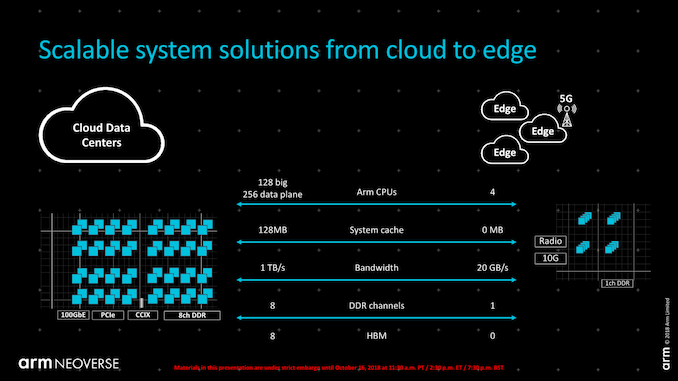
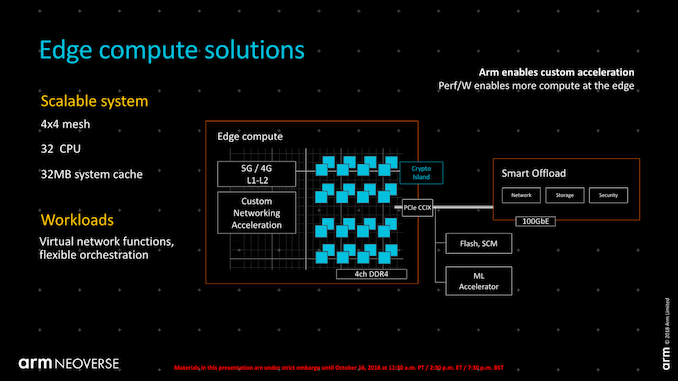
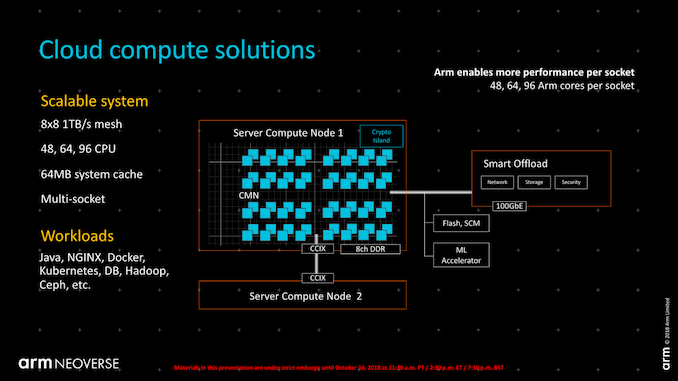
Arm went on to discuss more the various scaling possibilities that vendors can achieve by using Arm’s IP, varying from more simple configurations in edge devices up to very wide implementations for server CPUs, advertising the possibility of 48, 64 or 96 cores per socket in the maximum configuration.

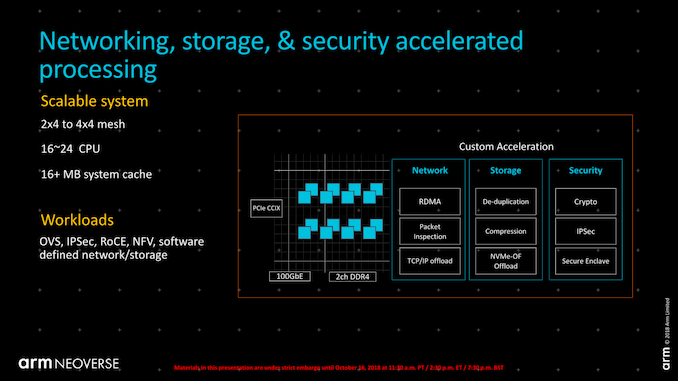
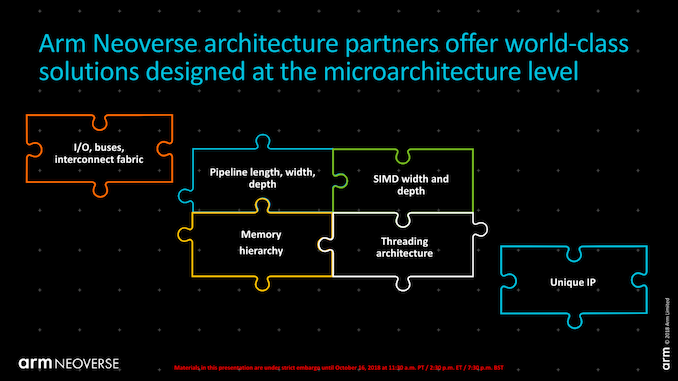
The one slide that really caught my eye and Arm notoriously went over quick was in regards to the offering for architecture partners. Here Arm wants to again communicate that it’s able to provide customised IP on demand, and alter things such as the interfaces to the cores, their memory hierarchy as well as the SVE units’ width and depth. Among these items is also “threading architecture”. While I’m not keen on guessing Arm’s intents here, I do wonder if this means we’ll be seeing SMT implemented in Arm’s Neoverse IPs?

While today’s announcement didn’t have any major technical unveiling, it does put to rest the question how Arm is going to name its new server cores, as well as publicly acknowledging roadmap names and goals for the coming years. Arm promised more details and announcements at TechCon – and we’ll be sure to report on the happenings in the comings days.


from AnandTech https://ift.tt/2RRjjff
via IFTTT
Huawei to announce new Matebook in November

Huawei to announce new Matebook in November

https://ift.tt/2AdacP2

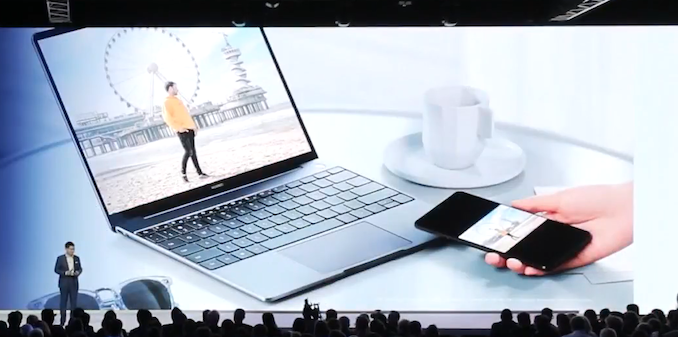
In the process of describing new features for the Mate 20 and Mate 20 Pro, the comments on one of the slides let slip that Huawei is set to announce a new Matebook this November. One of the features, according to the slides for the Mate 20 Series, is a single button sharing with the Mate 20 series phones in order to share 1000 photos in two seconds. The side showed what looked like a regular Matebook, not the Matebook X, so it could be that thee new laptop is set to be a standard Matebook replacement, but information about the new laptop is set going to be upcoming. We'll keep our ears to the ground for more information. 

Huawei's previous Matebook launch, the Matebook X Pro, was announced earlier this year with an Intel CPU and an NVIDIA GTX GPU. You can read our review here. 


from AnandTech https://ift.tt/2EniGqM
via IFTTT